

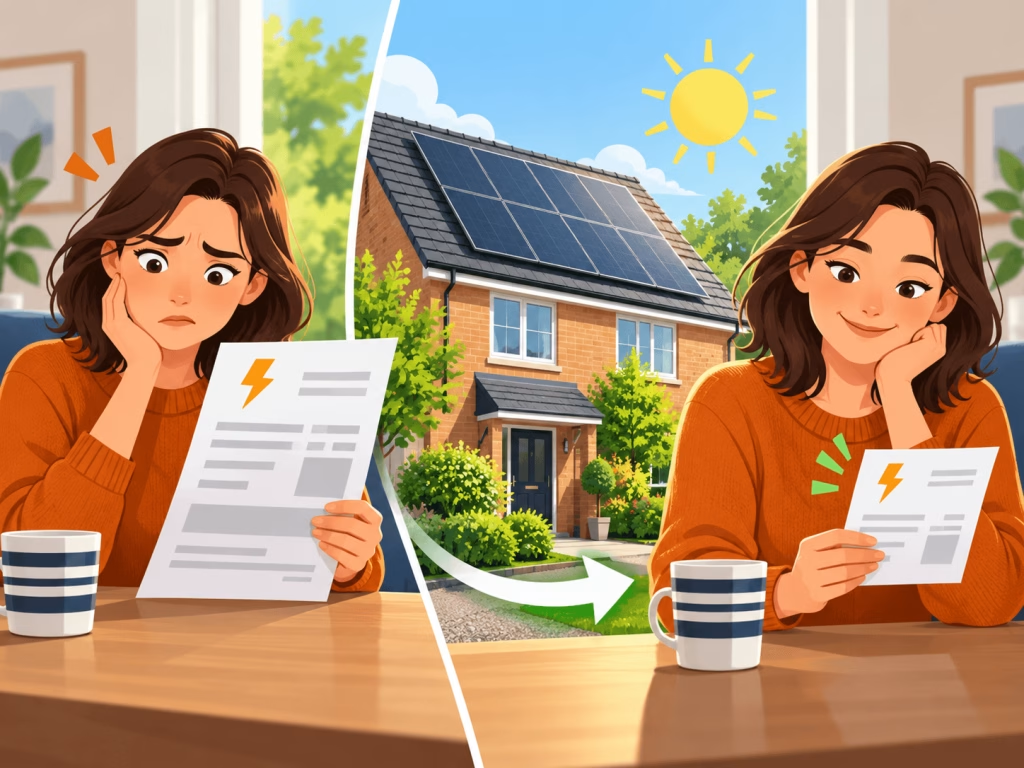
Yes, most households will still receive an electricity bill after installing solar panels. But the amount of electricity you need to buy from the grid can fall significantly.
How much you could save depends on much more than simply how many solar panels you install. Your electricity consumption, when you use electricity, the size and performance of your solar system, whether you have battery storage, your electricity tariff and even your lifestyle can all make a difference.
A two-bedroom home will typically have very different electricity requirements from a busy five-bedroom household, so we have included some representative examples below to help you understand where your home might sit.
The important point is that solar panels do not normally make your electricity supplier disappear. Instead, they allow you to generate some of the electricity you would otherwise have had to buy.
How much electricity might a two, three, four or five-bedroom home use?
There is no standard electricity consumption for a particular size of house. Two identical three-bedroom homes could have completely different bills.
One may have two occupants who are out all day. Another may have a family working from home, an electric vehicle, a tumble dryer running regularly and several computers, televisions and gaming systems.
However, property size can still give us a useful starting point.
Latest government National Energy Efficiency Data-Framework data for England and Wales shows median household electricity consumption of around 2,500 kWh a year overall, with consumption generally increasing as properties become larger. Ofgem also introduced 2,500 kWh as its revised medium Typical Domestic Consumption Value for electricity from July 2026.
The following examples are therefore intended as a guide rather than a prediction of what any individual household will use.
| Example home | Illustrative annual electricity use | Approx. electricity cost before solar* |
|---|---|---|
| 2-bedroom home | Around 2,200 kWh | Around £780 a year |
| 3-bedroom home | Around 2,700 kWh | Around £915 a year |
| 4-bedroom home | Around 3,500 kWh | Around £1,120 a year |
| 5-bedroom+ home | Around 4,650 kWh | Around £1,425 a year |
*These are illustrative electricity-only figures using the average Ofgem electricity unit rate and standing charge applying to a Direct Debit customer on a standard variable tariff between 1 July and 30 September 2026. Actual tariffs, regional rates and consumption vary, and energy prices change over time.
So if you live in a four-bedroom home, for example, this doesn’t mean you should expect to use exactly 3,500 kWh. It simply gives you a useful point of comparison.
Your own electricity bill or smart meter data is much more valuable when designing a solar installation.
Will solar panels completely remove my electricity bill?
Usually, no.
Solar panels generate electricity when daylight is available. Your home can use that electricity as it is produced, reducing the amount you need to take from the National Grid.
But there will still be times when your home needs more electricity than your panels are producing.
That might happen:
- overnight
- during periods of poor weather
- during the shorter days of winter
- when several high-demand appliances are being used at once
- when your solar system simply cannot generate enough to meet the property’s demand
At those times, electricity will normally be imported from the grid.
You will also generally continue paying your electricity supplier’s standing charge while you remain connected to the grid.
So rather than asking whether solar panels can completely eliminate your electricity bill, it is often more useful to ask:
How much electricity could I stop buying from the grid?
That is where solar starts to become much more interesting.
What happens to my electricity during a sunny day?
Imagine your solar panels are generating electricity at midday.
Your fridge is running, somebody is working on a laptop and the washing machine is on.
The electricity generated by the solar panels is available to power those appliances first.
If the house needs 1.5 kW at that moment and your solar panels are producing 3 kW, the solar system is generating more electricity than the house currently needs.
The remaining electricity can then either:
- be stored in a home battery, if you have one, or
- be exported to the electricity grid.
Now imagine the opposite situation.
Your solar panels are producing 1 kW but the house is consuming 3 kW.
The solar generation still contributes, but the remaining 2 kW needs to come from another source, usually the grid or a battery.
This balance between generation and consumption is changing continually throughout the day.
Why does it matter when I use electricity?
This is one of the most important things to understand about solar.
Two households might each use 3,000 kWh of electricity every year, but solar could affect their bills differently.
Consider one household where somebody works from home. Washing, cooking, computers and other appliances may be running while the solar panels are generating.
Now consider another where everyone leaves home early in the morning and returns at 6pm.
The second home may produce plenty of solar electricity during the day, but much of its demand happens later.
Without battery storage, surplus daytime generation may be exported and the household may then buy electricity from the grid in the evening.
That is why a good solar assessment should look at more than your annual electricity consumption.
How and when you use electricity matters too.
What difference can a battery make?
Battery storage allows some of the solar electricity you don’t use immediately to be saved for later.
For example, your panels may generate surplus electricity between 11am and 3pm.
Instead of exporting all of it, a battery can store some of that energy.
Then, when you cook dinner, watch television or use appliances later in the evening, the home can draw electricity from the battery rather than immediately buying it from the grid.
Once the battery reaches its minimum charge level, your home returns to using grid electricity when there isn’t enough solar generation.
Energy Saving Trust explains that battery storage can reduce the need to import electricity from the grid during times when your panels aren’t generating enough electricity.
A battery does not automatically make sense for every household, however. Its value depends on factors including your consumption pattern, solar generation, tariff, battery capacity and how the system is configured.
What happens to solar electricity I don’t use?
Solar electricity that isn’t being used by your home or stored in a battery can usually be exported to the grid.
Eligible households can receive payments for exported electricity through the Smart Export Guarantee (SEG), or through other eligible export arrangements offered by electricity suppliers.
Under the Smart Export Guarantee, participating electricity suppliers set their own export tariffs and terms. Ofgem requires mandatory SEG suppliers to offer an export tariff to eligible generators, but it does not prescribe a single national payment rate.
This creates two different financial benefits from solar electricity.
The first is avoided electricity cost.
If your panels generate a unit of electricity which your home uses directly, you don’t need to buy that unit from your supplier.
The second is export income.
If you don’t need that electricity and export it, you may receive an export payment for it.
Those two values are not necessarily the same.
For many households, using their own solar electricity effectively can therefore be an important part of maximising the benefit of the system.
Could my electricity bill ever reach £0?
Potentially, your net electricity costs over a particular period could become very low.
There may even be situations where export payments offset much of the electricity you have purchased.
But this isn’t the same as assuming that installing solar panels means you will never receive another electricity bill.
Most grid-connected households will still have:
- a standing charge
- some periods of grid electricity consumption
- lower solar generation during winter
- occasional periods where electricity demand exceeds solar generation
The important figure is therefore not simply whether a bill arrives.
It is how much electricity you are buying from the grid over the year, how much your solar system generates and how much value you receive from electricity that you export.
What happens to my bill in winter?
Solar panels generate electricity throughout the year, but generation is not evenly distributed between the seasons.
Long summer days provide far more opportunity for solar generation than short winter days.
There may therefore be summer periods when a well-designed system produces much more electricity than the household requires during daylight hours, while the same home imports considerably more electricity during winter.
This is normal.
Solar should therefore be considered over the course of a year rather than judging its performance from a particularly sunny June or a dark December.
When an MCS-certified solar installation is designed, its expected annual output can be estimated using factors including:
- the installed capacity of the solar array
- geographical location
- roof orientation
- roof pitch
- shading
That gives a much better basis for estimating expected generation than simply counting the number of panels on the roof.
Does the direction my roof faces affect my electricity savings?
Yes.
The amount of electricity a solar system can generate depends partly on the orientation and pitch of the panels, together with shading and the location of the property.
A south-facing roof can be excellent for solar, but it is certainly not the only roof that can work.
East- and west-facing arrays can also perform well and may sometimes have an interesting advantage because their generation is spread differently through the day.
An east-facing array may begin generating earlier in the morning, while a west-facing array can continue producing later into the afternoon.
The right design therefore depends on the building itself and when electricity is normally required.
What about an electric car?
An electric vehicle can substantially change a household’s electricity consumption.
Someone moving from a petrol or diesel vehicle to an EV may suddenly start using considerably more electricity at home.
That doesn’t necessarily make solar less attractive.
Quite the opposite.
If the vehicle is at home while solar electricity is being generated, some of that electricity can potentially be used to charge it instead of being exported to the grid.
Where charging happens overnight, battery storage and suitable time-of-use electricity tariffs may also become part of the overall system design.
This is why historic electricity consumption alone doesn’t always tell the whole story.
If you are planning to buy an electric vehicle, install a heat pump, add an extension or make another significant change to your home, tell your solar installer.
Your future electricity requirements may matter just as much as your current ones.
How can I reduce the amount of electricity I buy from the grid?
Solar isn’t just about what is installed on the roof. How the household uses electricity can also make a difference.
Simple changes can include running flexible appliances when your panels are generating strongly rather than automatically using them in the evening.
Depending on your household, that might include:
- washing machines
- dishwashers
- tumble dryers
- EV charging
- other controllable electrical loads
Modern monitoring systems can also show when your panels are generating electricity, how much your home is consuming and, where a battery is fitted, whether electricity is being stored or drawn from the battery.
This makes it much easier to understand where your electricity is coming from.
So how much could solar reduce my electricity bill?
There isn’t a responsible one-size-fits-all answer.
Someone telling every homeowner that solar panels will reduce their electricity bill by a particular percentage is ignoring too many variables.
A meaningful estimate needs to consider:
- your actual annual electricity use
- when you use that electricity
- roof space
- roof orientation and pitch
- shading
- geographical location
- proposed solar system size
- whether battery storage is included
- expected self-consumption
- expected exports
- your electricity and export tariffs
- planned future changes such as an EV or heat pump
This is why system design matters.
The aim shouldn’t simply be to fit as many panels as possible. It should be to understand the property, understand how electricity is used and design an appropriate system around it.
Will I still pay an electricity bill after installing solar panels?
For most households, yes.
But that doesn’t mean the bill will look anything like it did before.
Instead of buying virtually all of your electricity from the grid, you have the opportunity to generate part of it yourself.
A well-designed system can also combine solar generation with battery storage, allowing some surplus daytime electricity to be used later.
And electricity that you don’t need may be exported back to the grid in return for an export payment.
The result is a very different relationship with your electricity supplier.
The question changes from:
“How much electricity do I use?”
to:
“How much electricity do I still need to buy?”
At Phase Energy, we design solar and battery systems around the individual property and the way electricity is actually used. By looking at your current consumption, your property and your future requirements, we can provide a much more meaningful picture of what solar could deliver for your home.
Frequently Asked Questions
Normally, yes. If your property remains connected to the electricity grid and you retain a conventional electricity supply, you will normally continue to pay your supplier’s standing charge.
Solar panels reduce the electricity you need to buy but do not normally remove the grid connection itself.
Yes. Solar photovoltaic panels generate electricity from daylight rather than requiring bright sunshine.
Generation will generally be lower under heavily overcast conditions than on a bright sunny day, but the panels can still produce electricity.
Solar panels themselves do not generate electricity at night.
Without battery storage, your home will normally draw electricity from the grid once solar generation has stopped.
With a battery, electricity stored earlier in the day may be available to use during the evening and night until the battery reaches its minimum charge level.
No. Solar panels can operate perfectly well without battery storage.
A battery can increase the amount of your own generated electricity that you are able to use by storing surplus energy for later.
Whether a battery is worthwhile depends on your electricity consumption, when you use electricity, your solar system and your tariff.
Yes, eligible solar installations can export surplus electricity and receive payment through a suitable export tariff, including tariffs offered under the Smart Export Guarantee.
Rates and terms vary between electricity suppliers, so it is worth comparing the options available to you.
Across particular days or periods, a solar and battery system may be capable of supplying a very high proportion of a household’s electricity requirements.
Across an entire year, however, most grid-connected UK households will still import some electricity because solar generation and household demand vary throughout the day and throughout the seasons.
The best way to understand what is realistic for your home is to compare your actual electricity consumption with the predicted generation of a system designed specifically for your property.